Only a lab test can tell you for sure. Your photo helps us send the right kit.
Plenty of people would rather have a smooth ceiling than a swirly one. There are four usual ways to get there: paint it, skim it with a thin coat of plaster, cover it with new plasterboard, or take the old coating off.
They're not equal. Some leave the old coating untouched. Others break it up. If the coating went up before 2000 and might contain asbestos, that difference is what matters.
The four options at a glance
| The job | What it does to the old coating | Test first? |
|---|---|---|
| Painting | Covers it without breaking it, as long as nobody sands or scrapes it first | Not needed just to paint. Worth knowing for later work. |
| Skimming | The plaster itself covers it, but the preparation often scrapes the peaks off | Yes, before any preparation |
| Overboarding (new plasterboard screwed over the top) | Every screw goes through the coating | Yes |
| Stripping it off (scraping, steaming or gel strippers) | Breaks it up. The most disturbance of all | Yes, and use a professional if asbestos is found |
Why covering it up is a recognised option
Covering asbestos that's in good condition is one of the ways professionals manage it. HSE's list of lower-risk, non-licensed work includes "encapsulation and sealing-in work" on asbestos materials in good condition. HSE's general advice is that asbestos materials in good condition are often best left where they are.
So a skim or a coat of paint over a sound textured ceiling is a sensible way to live with it. The catch is the preparation.
The peaks problem
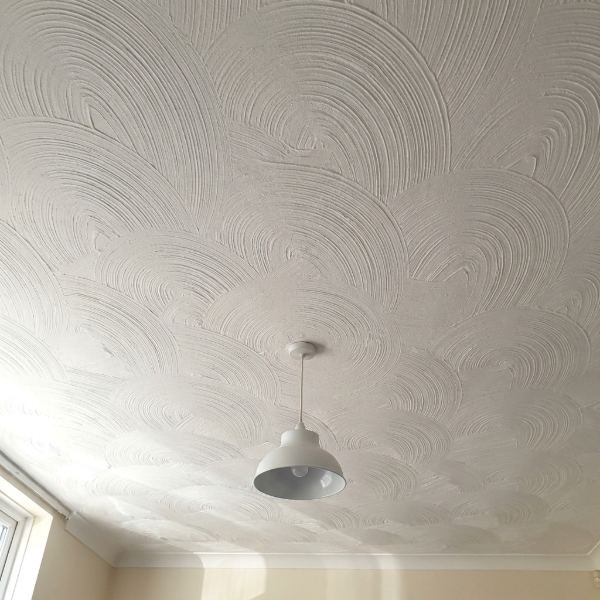
Deeply patterned ceilings often have sharp peaks. Before skimming, plasterers usually want a flatter surface, and the quick way is to knock the peaks off with a scraper. That is scraping the coating. It's exactly the kind of work that releases dust.
HSE's task sheet for tradespeople removing a small area of textured coating carries a clear warning: never scrape through or sand down textured coatings, and don't use power tools to cut through them.
What this means for you:
- Test before the plasterer comes, not on the day.
- If the lab finds asbestos in the coating, ask your plasterer how they'll prepare the ceiling without scraping or sanding it. If they can't, overboarding may be the better choice.
- If the lab finds no asbestos in that coating, they can prepare it in the normal way. The result covers only the coating that was sampled, so test other ceilings separately.
Painting
Painting a textured ceiling that's in good condition doesn't break it up. A light wipe to clean it is fine. Avoid anything abrasive.
Don't sand it to "key" the surface for the paint, and don't scrape off loose or flaking bits first. If parts of it are flaking, that's damage, and damaged coating shouldn't be touched or sampled by you. Send us a photo instead.
Overboarding
New plasterboard screwed over the old ceiling hides the pattern without lifting it. But each screw passes through the coating, and a ceiling takes a lot of screws. HSE has a separate task sheet for tradespeople on "inserting and removing screws through textured coatings", which tells you this is treated as work on the material.
It's still a gentler job than stripping. Test first so the fitter knows what they're working with.
Stripping it off
This is the job most worth leaving to a professional if the coating contains asbestos. For people at work, HSE says large-scale removal of textured coatings using steaming or gelling methods is notifiable non-licensed work. That means extra rules, including telling the authorities before the work starts. HSE's sheet for removing even a small area, about one square metre, still involves sheeting the room, wetting or steaming the coating, scraping it gently into a dustpan, and bagging everything as asbestos waste.
In your own home you're not "at work", but the dust is the same. UKHSA says it does not recommend DIY removal of asbestos without advice.
If the lab finds no asbestos in your coating, stripping becomes an ordinary, if messy, decorating job.
After it's covered
Skimming or boarding over a coating that contains asbestos doesn't remove it. It's still there, under the new surface. That matters later:
- Fitting downlights or a fan later means cutting through it. See drilling and downlights.
- Keep the lab certificate with your house papers, with a note of which ceiling it covers.
- Tell anyone who works on that ceiling in future.
- If you sell, a buyer's surveyor may ask. A certificate is far better than guesswork. See selling a house with asbestos.
Taking the sample
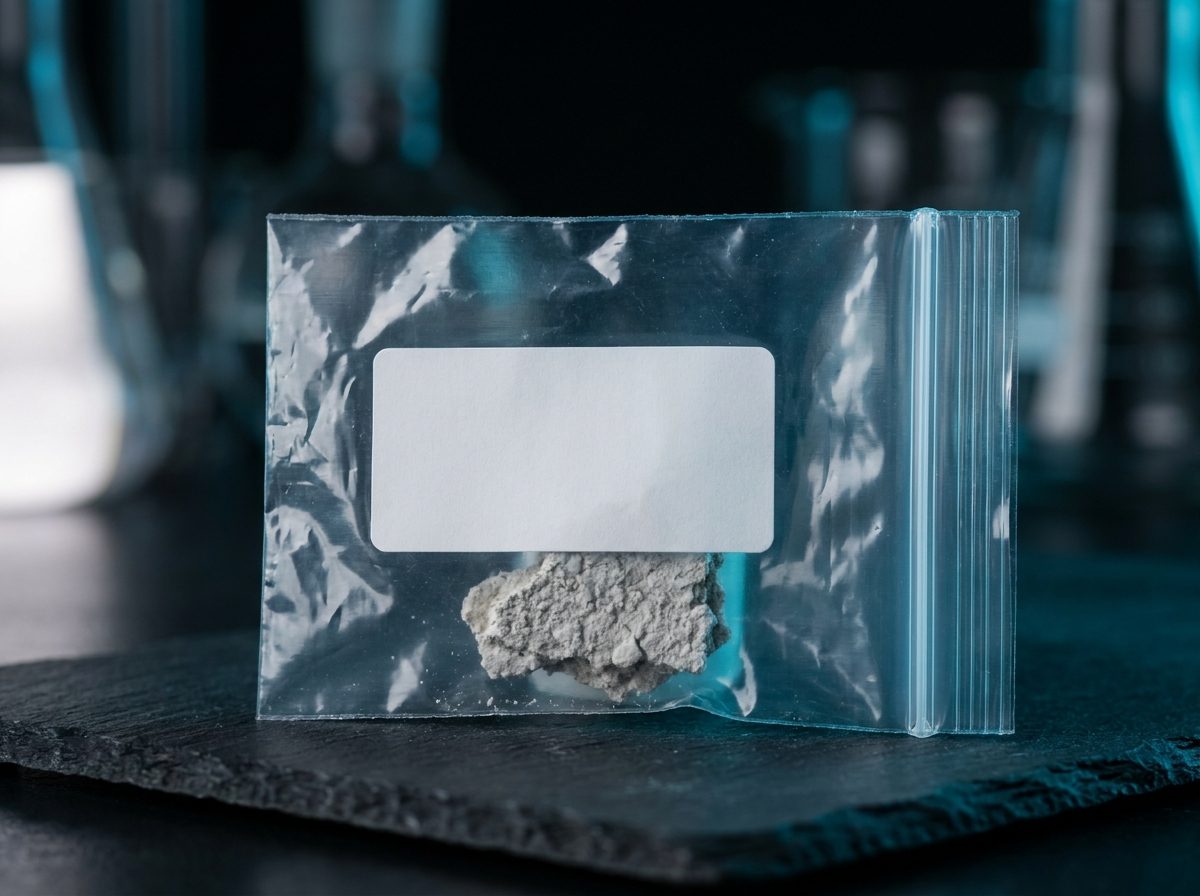
Take the sample before any preparation, from an out-of-the-way spot such as a corner or above a cupboard. Mist it with water, then scrape a small piece of the coating, through its full depth, straight into the bag. HSE's survey guide describes sampling textured coatings in much the same way: carefully scraping with a screwdriver or narrow scraper, with the bag held underneath.
If more than one ceiling is involved, or a ceiling was patched or redone at some point, each part counts as a separate area. Our photo check will suggest how many.
- Send us a photo of the ceiling, and tell us what you're planning: start the free photo check.
- We'll point at what's worth testing and how many samples. Only the lab can tell you whether the coating contains asbestos.
- Kits are launching soon. Your sample will be analysed by a UKAS-accredited laboratory, named on every certificate.
Questions people ask
Can I plaster over Artex without testing it?
You can skim over a sound coating without disturbing it. The risk is in the preparation: scraping off peaks or sanding the surface. Test first, so you and your plasterer know whether that preparation is a problem.
Can I paint over Artex?
Painting a textured coating in good condition doesn't break it up, so painting on its own is generally not a problem. Don't sand it or scrape it first. If it's flaking, don't touch it. Send us a photo.
Does skimming over Artex get rid of the asbestos?
No. It covers the coating and holds it in place, which is a recognised way of managing it, but the asbestos is still there underneath. Keep your result on file and tell anyone who drills or cuts that ceiling later.
Can I scrape Artex off myself? Do I need a licence?
HSE says most work on textured coatings doesn't need a licence, even for professionals, but large-scale removal by steaming or gel is notifiable work for people at work. In your own home, UKHSA does not recommend DIY removal of asbestos without advice. Test first. If asbestos is found, use a professional.
Will paint on top stop the test working?
No. The lab examines the sample, including its layers, and HSE's guide for analysts says layered samples should have each layer recorded separately. Make sure your sample goes through the full depth of the coating, not just the paint.
Sources
- HSE, Non-licensed work ("Encapsulation and sealing-in work on asbestos-containing materials (ACMs) that are in good condition"; large-scale removal of textured coatings by steaming or gelling is NNLW), updated 2024-02-23: www.hse.gov.uk/asbestos/licensing/non-licensed-work.htm
- HSE, Asbestos essentials task sheet A28, "Removing textured coating from a small area, for example 1m2" (published 09/17): www.hse.gov.uk/pubns/guidance/a28.pdf
- HSE, Asbestos essentials sheet A0, "Introduction to Asbestos essentials" ("Non-licensed work includes most work on asbestos-containing textured coatings"): www.hse.gov.uk/pubns/guidance/a0.pdf
- HSE, Asbestos essentials index (A27, "Inserting and removing screws through textured coatings"): www.hse.gov.uk/asbestos/essentials/index.htm
- HSE, Asbestos FAQ ("it is often best to leave them where they are"), updated 2025-09-04: www.hse.gov.uk/asbestos/faq.htm
- HSE, HSG264 Asbestos: The survey guide, 2nd edition 2012, para 120 (sampling textured coatings): www.hse.gov.uk/pubns/priced/hsg264.pdf
- HSE, HSG248 Asbestos: The analysts' guide, 2nd edition 2021, para A2.70 (layered samples recorded separately): www.hse.gov.uk/pubns/priced/hsg248.pdf
- UKHSA, Asbestos: general information (DIY removal), updated 15 May 2025: www.gov.uk/government/publications/asbestos-properties-incident-management-and-toxicology/asbestos-general-information
- Our own research notes (B), section 4, questions 20 and 21 (forum demand for this topic), 22–23 Oct 2026.
Updated 23 October 2026