Only a lab test can tell you for sure. Your photo helps us send the right kit.
This question usually gets a line in the small print. Here it gets a page, material by material, so you can see where the line falls and why.
First, the official advice, because you deserve to hear it from us. HSE recommends that the person taking a sample is "fully trained and competent", and warns that sampling "may generate many free fibres in higher-risk materials". HSENI, the regulator in Northern Ireland, says taking the sample yourself is not recommended, because of the risk of fibre release.
For the higher-risk materials, we agree completely, and we say so plainly below. For a few common, firmly bound materials in good condition, a careful home sample is a reasonable choice for some people. HSE treats work on those materials as lower-risk work. The choice is yours. If you have any doubt, use a surveyor.
Never sample anything that's damaged. If it's crumbling, powdery, flaking, broken, or has been in a fire or flood, don't touch it. Keep people out of the area and send us a photo.
The list
| Material | Sample it yourself? |
|---|---|
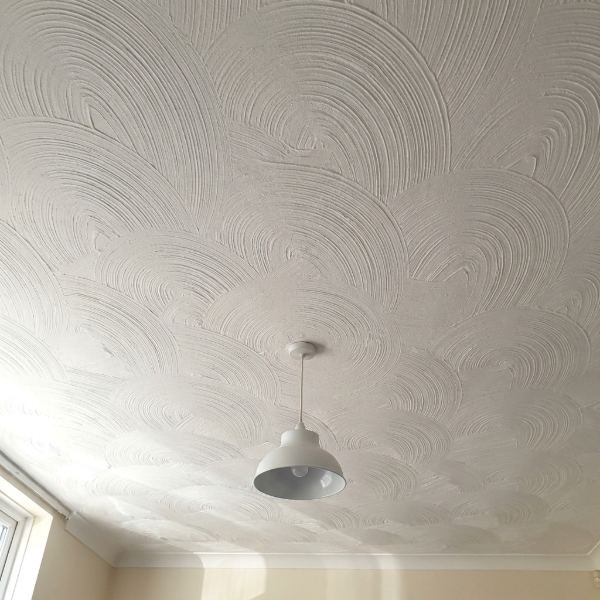
| Artex and other textured coatings, in good condition | Yes, with care |
| Vinyl and thermoplastic floor tiles, and the black adhesive under them | Yes, with care |
| Asbestos cement you can reach from the ground: shed walls, gutters, downpipes, flue pipes, water tanks | Yes, with care, from an edge |
| Bitumen roofing felt, damp-proof course, mastic, sealant, window putty | Photo first |
| Toilet cisterns, window sills, bath panels | Photo first |
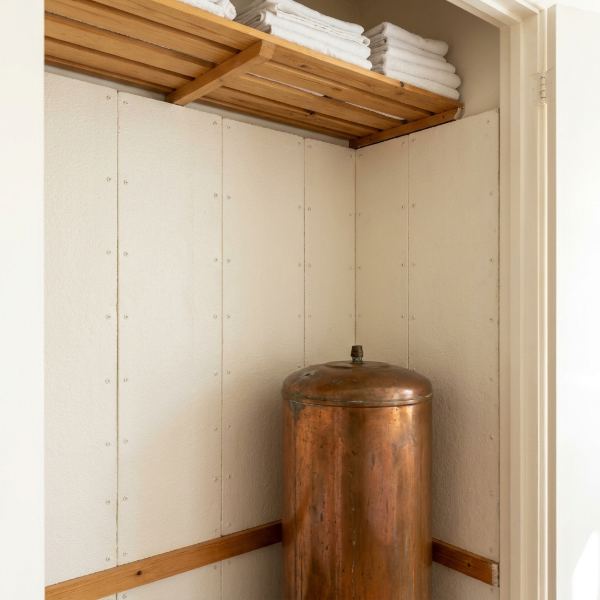
| Insulation board (AIB): ceiling tiles, panels behind heaters, airing cupboards, boxing-in, fire doors, some soffits | Don't sample it yourself. Send us a photo first. |
| Cement roof sheets, if you'd have to go on or up to the roof | Never |
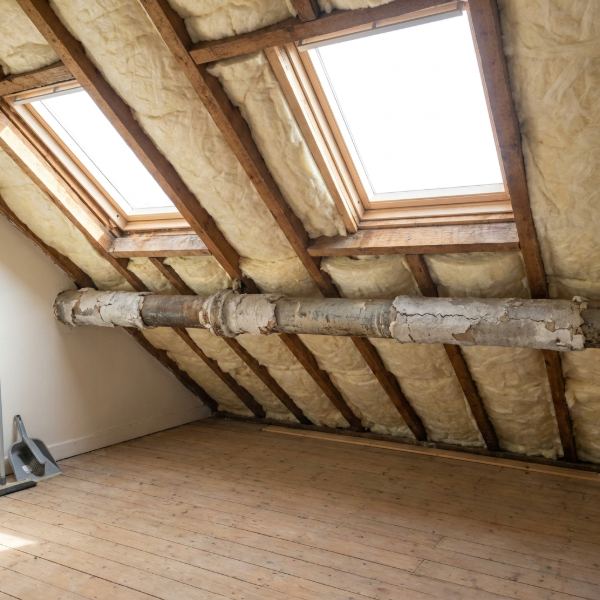
| Pipe, boiler and tank lagging | Never |
| Sprayed coatings ("limpet") on ceilings, beams or walls | Never |
| Loose-fill insulation in lofts, walls or under floors, including vermiculite | Never |
| Anything damaged, crumbling or powdery | Never |
| Anything inside a fuse box, heater, storage heater, boiler or other appliance | Never |
| Anything you'd need a power tool to get a piece off | Never |
"Yes, with care": why these ones
Textured coatings. The asbestos, where there is any, is a few per cent of white asbestos held in the coating. HSE describes most work on textured coatings as non-licensed work, and its survey guide describes sampling them by carefully scraping a little coating into a container held underneath. See our Artex guide.
Floor tiles and adhesive. The fibres are bound into plastic or bitumen. HSE has a task sheet for trades on removing these tiles and their mastic as non-licensed work. A tile that's already loose is often the easiest place to take a sample. The tile and the adhesive can be different materials, so they may need a sample each. See floor tiles.
Asbestos cement. The fibres are held tightly in cement. HSE's survey guide describes taking a small piece from an edge or corner, about 5 cm². It also warns that samples should not be collected from roofs without special safety precautions, because people fall through fragile sheets. Ground level only. See cement sheets.
"With care" means doing it the way HSE's survey guide describes:
- mist the spot with water first, to keep dust down;
- put a sheet down underneath;
- use a hand tool, take a small piece, and put it straight into a sealable bag, then seal that inside a second bag;
- label it, and note where it came from (a photo helps);
- leave the spot clean, and cover it with tape or a dab of paint.
Wear the right protection. HSE says a "dust mask" is useless for asbestos. You need a respirator to the FFP3 standard, a disposable overall and single-use gloves. HSE also says these respirators are not suitable for people with beards or stubble, because they can't seal properly.
"Photo first": why we want to see it
Felt, mastics, putty, cisterns and sills are usually firmly bound, but they can be hard to sample cleanly and some look like materials that need more care. A photo lets us tell you whether a home sample makes sense.
Insulation board: don't sample it yourself
Insulation board looks harmless: a flat, matt, often painted panel. But it's softer than cement and breaks more easily. HSE's survey guide says it usually contains 15 to 25% brown asbestos (amosite), sometimes mixed with white, and older boards up to 40%. HSE says most work with insulation board needs a licence.
So we don't recommend sampling it yourself. Send us a photo first and we'll tell you honestly whether you need a licensed professional. Insulation board is easy to confuse with cement sheet, especially on soffits, which is exactly why we'd rather see it. See asbestos insulation board.
"Never": the materials to leave to a professional
Cement roof sheets from above. Not because of what's in them, but because of what's under you. Old sheets can give way without warning. HSE's survey guide says samples should not be collected from roofs without special safety precautions. See garage roofs.
Lagging. HSE's survey guide puts the asbestos content of old lagging anywhere from 6 to 85%, and it sheds fibres easily. Work that may disturb pipe lagging is licensed work. See pipe lagging.
Sprayed coatings. Usually 55 to 85% asbestos, according to HSE's survey guide. Removing them is licensed work. Professionals sample them using special wetting and coring methods, not a scraper.
Loose fill. Loose asbestos insulation can easily get into the air if disturbed. Work involving it is licensed. Some vermiculite loft insulation (small, pebble-like grey-brown or silver-gold granules) came from a mine in the United States whose vermiculite was contaminated with asbestos. The US Environmental Protection Agency advises leaving it undisturbed. See sprayed coatings and loose fill.
Damaged material. Even for professionals, HSE says removing asbestos in poor condition, for example after a flood or fire, will normally be notifiable work.
Inside appliances and electrics. Fuse boxes, heaters and boilers can contain asbestos parts, as well as electricity and sometimes gas. Leave them to the trades.
Who shouldn't use a home kit at all
- Landlords, businesses and tradespeople, for their own duties. HSE's survey guide says that for people at work, asbestos surveying and sampling is likely to count as work with asbestos, needing a risk assessment and a plan of work. See renting and asbestos.
- Anyone who needs a survey, for example before major building work, or to meet a legal duty to manage asbestos. HSE says asbestos surveys should only be done by competent surveyors.
- Anyone with a beard or stubble, unless someone else does the sampling, because the respirator can't seal.
- Not sure which row your material is in? Start the free photo check. We'll point at what's worth testing, how many samples, and anything on the "never" list. We'll never tell you something "is asbestos" or "is safe" from a picture. Only the lab can say what a material is.
- If it's on the "never" list, don't touch it. We'll point you to the right kind of professional.
- Kits are launching soon. Your sample will be analysed by a UKAS-accredited laboratory, named on every certificate.
Questions people ask
Can I test for asbestos myself? Is it legal?
Taking a sample doesn't need a licence. HSE lists collecting samples as non-licensed work even for people doing it as their job, and in your own home you're not "at work". But HSE and HSENI both recommend a trained person, and some materials should never be sampled by anyone without training. Use the list above.
How big a sample do I need?
Small. HSE's survey guide suggests about 3 to 5 cm² of surface, taken through the full depth of the material. That's roughly the size of a 20p coin. For asbestos cement it suggests about 5 cm², so the lab can search properly for the rarer types.
How many samples do I need?
One for each different material, colour or area. Ceilings textured at different times count separately. Floor tiles of different colours count separately, and the adhesive may need its own. Our photo check will suggest a number.
Is my loft insulation asbestos?
Much loft insulation is modern mineral wool, but you can't be sure by looking. Loose, fluffy or pebble-like insulation should never be sampled by you. Keep out of the loft, don't store things on it, and send us a photo.
Sources
- HSE, Asbestos analysts and surveyors ("it is recommended that the person sampling is fully trained and competent"; "Taking the sample may generate many free fibres in higher-risk materials"), updated 2025-07-28: www.hse.gov.uk/asbestos/analysts-surveyors.htm
- HSENI, Asbestos Advisory Service ("Taking the sample yourself is not recommended"): www.hseni.gov.uk/articles/asbestos-advisory-service
- HSE, Non-licensed work (sampling; textured coatings; floor tiles; cement; licensable work list), updated 2024-02-23: www.hse.gov.uk/asbestos/licensing/non-licensed-work.htm
- HSE, Notifiable non-licensed work (materials in poor condition, flood or fire damage), updated 2024-09-06: www.hse.gov.uk/asbestos/licensing/notifiable-non-licensed-work.htm
- HSE, Asbestos FAQ (AIB licensing; surveys by competent surveyors), updated 2025-09-04: www.hse.gov.uk/asbestos/faq.htm
- HSE, HSG264 Asbestos: The survey guide, 2nd edition 2012: para 16 (sampling as work), para 101 (samples of about 3–5 cm², full depth), paras 110–120 (how samples are taken; roofs; about 5 cm² for cement), Appendix 2 (asbestos content of lagging, sprays, insulation board, loose fill): www.hse.gov.uk/pubns/priced/hsg264.pdf
- HSE, Asbestos essentials EM6, PPE including RPE (dust mask "useless"; FFP3; beards) (09/17): www.hse.gov.uk/pubns/guidance/em6.pdf
- HSE, Asbestos essentials index (trade task sheets A21, A23, A30–A33, A37): www.hse.gov.uk/asbestos/essentials/index.htm
- US EPA, Protect your family from asbestos-contaminated vermiculite insulation, updated 17 April 2026: www.epa.gov/asbestos/protect-your-family-asbestos-contaminated-vermiculite-insulation
- Our own research notes (C), section 3 (the never-sample list and its sources), 22–23 Oct 2026.
Updated 23 October 2026